
The first quarter of 2026 told two different stories. The broader stock market fell as investors reacted to Middle East conflict and stepped back from large technology names, but Industrials was one of the few sectors to finish higher. Strong demand for defense equipment, the ongoing buildout of AI data centers, and the return of manufacturing to the United States continue to draw capital into real-economy businesses.
Valuations moved higher across the group, with specialty contractors and aerospace suppliers earning the richest multiples. Deal activity also picked up for the second quarter in a row, helped by patient private equity buyers and companies reshaping their portfolios.
Sector Performance
Market Cap Key Takeaways
Industrials went its own way in Q1 2026. The S&P 500 fell about 4.3% for the quarter as investors shifted out of large technology stocks and absorbed the shock of joint U.S. and Israeli strikes against Iran.1 Even so, all five industrial sectors tracked here finished the quarter higher.2
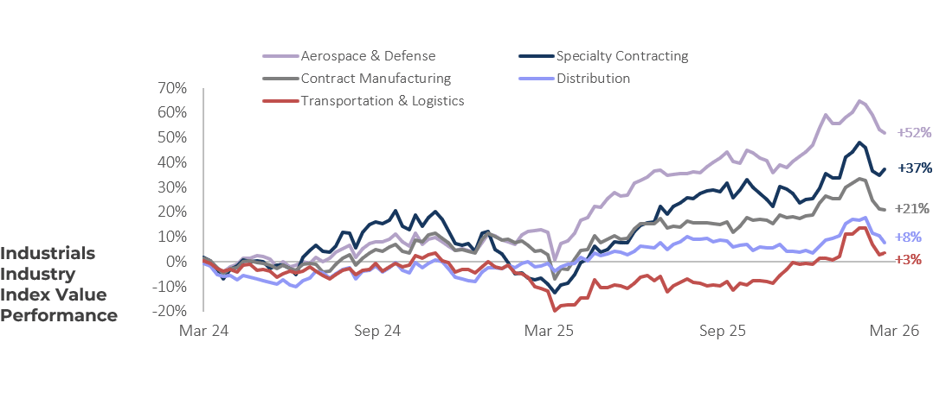
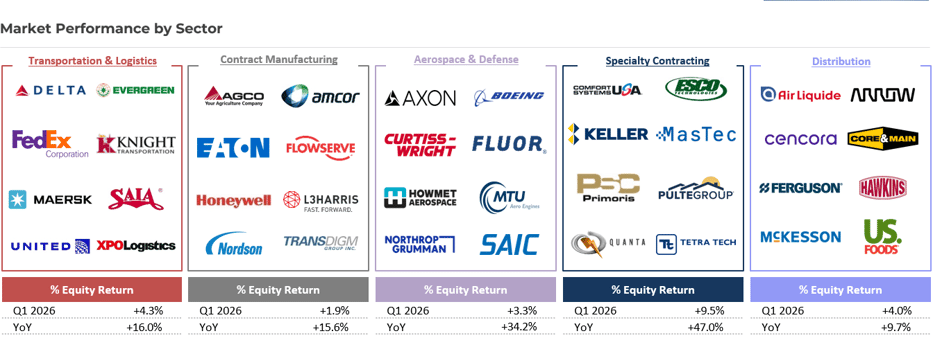
Specialty Contracting led the group, up 9.5% for the quarter and 47.0% over the past year. Investors are paying up for electrical, mechanical, and civil contractors that work directly on AI data centers and power grid upgrades. Moody’s expects roughly $3 trillion of global data center spending over the next five years, and a real share of that work falls to specialty trades handling substations, cooling systems, and site prep.3
Aerospace & Defense followed with a 3.3% quarterly gain and 34.2% over twelve months. The FY2026 budget is pushing spending toward missiles, missile defense, and shipbuilding, and Boeing and Airbus backlogs remain full.4 Transportation & Logistics (4.3%), Distribution (4.0%), and Contract Manufacturing (1.9%) each posted solid gains, helped by a firmer factory backdrop. The ISM Manufacturing PMI rose for a third straight month to 52.7 in March, the strongest reading since August 2022.5
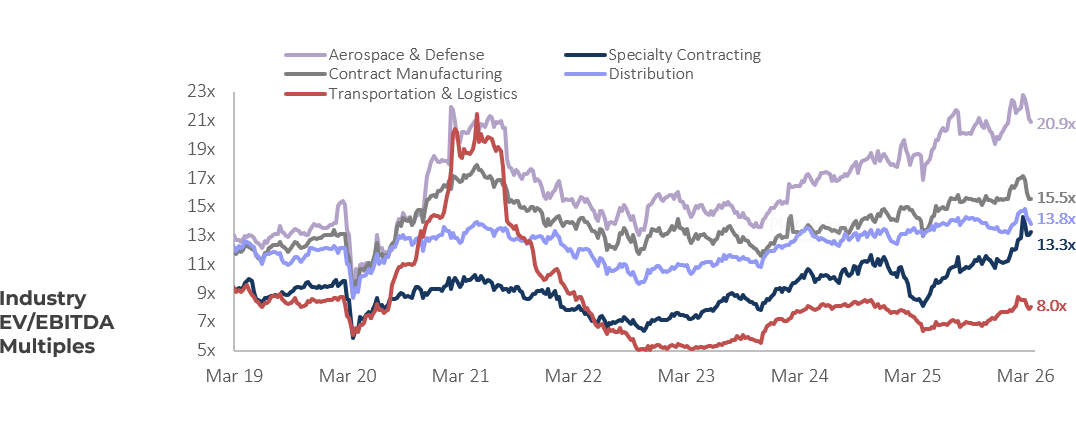
Valuations moved up across the board, though not evenly. Aerospace & Defense traded at 20.9x EV/EBITDA, up 13.0% from a year earlier. Specialty Contracting multiples re-rated to 13.3x, a 58.2% jump from 8.4x twelve months earlier. Contract Manufacturing (15.5x), Distribution (13.8x), and Transportation & Logistics (8.0x) each saw double-digit multiple gains over the past year. The common thread is simple. Buyers are paying up for businesses with visible backlogs and durable demand.
Dinan Index Perspective
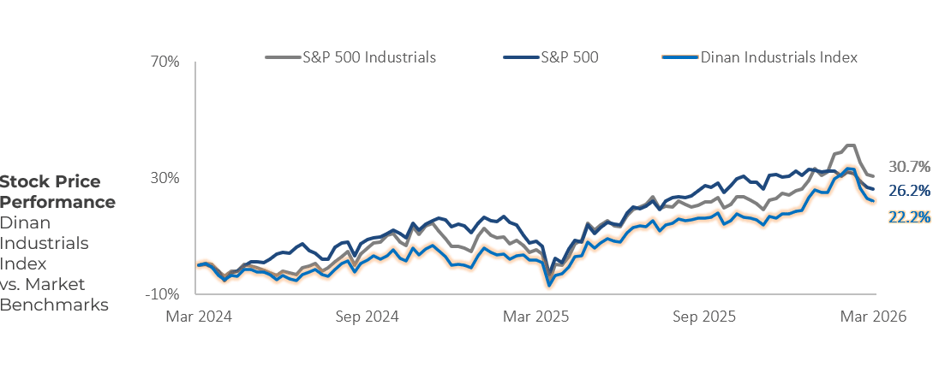
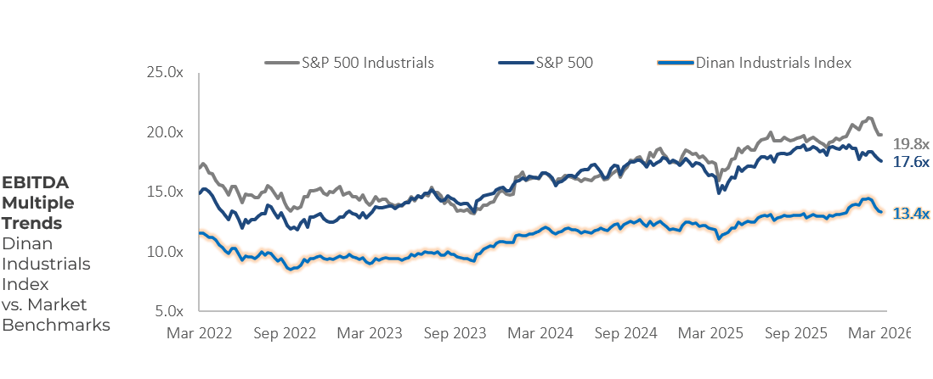
As a supplemental lens, the Dinan Industrials Index† added 3.7 percentage points in the quarter, bringing its total return since inception to 22.2%. That puts it roughly in line with the S&P 500 Industrials, which added 5.1 points and stands at 30.7% since inception. The broader S&P 500 gave back 6.2 points in Q1 as large technology names struggled.
Dinan’s internal tracking shows middle-market industrials multiples at 13.4x EBITDA, up 12.9% from a year ago. That move is on the same trend as the S&P 500 Industrials (19.8x) and the broader S&P 500 (17.6x). The gap between middle-market and large-cap multiples is a familiar feature of the asset class, but the direction on both is unmistakable.
M&A Activity and Transaction Environment
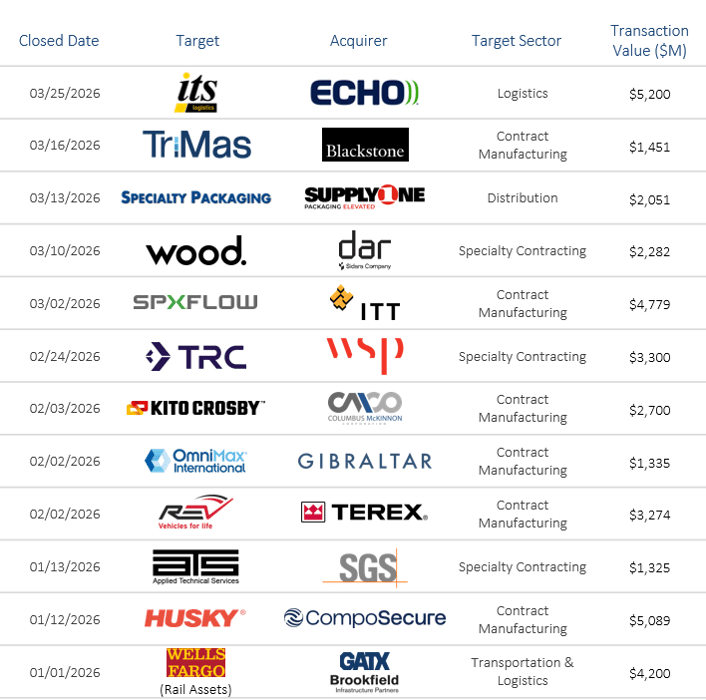
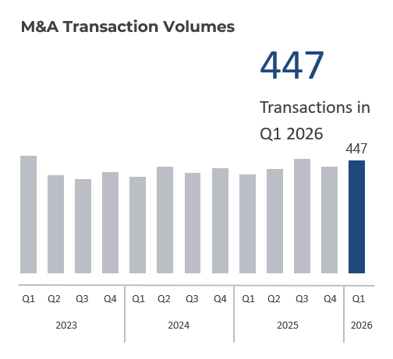
Industrials deal count hit 447 in Q1 2026, up 5.7% from the prior quarter and 14.0% higher than a year ago. Activity stayed concentrated in Contract Manufacturing and Specialty Contracting, the same sectors where multiples moved the most. Standout closings included Blackstone’s $1.5 billion purchase of TriMas, ITT’s $4.8 billion buyout of SPX Flow, Lone Star Funds’ $4.0 billion take-private of Hillenbrand, and CompoSecure’s $5.1 billion combination with Husky.
The buyer mix tells the story. Private equity firms moved aggressively alongside strategic buyers, helped by record cash balances ready to deploy and rates settling into the mid-3% range.6 Aerospace & Defense dealmaking was especially active. PCE Companies reports trailing twelve-month median multiples of 18.87x TEV/EBITDA, with revenue multiples at a four-year high, as buyers competed for mission-critical businesses.7 Transportation & Logistics also saw outsized activity, with GATX and Brookfield Infrastructure Partners closing on $4.2 billion of Wells Fargo rail assets. The deal points to steady investor interest in infrastructure-style industrial exposure.
Outlook & What to Watch
Near-term, the path depends on how quickly the Iran conflict’s pricing impact eases and whether tariff volatility keeps settling down following the Supreme Court’s March ruling against IEEPA duties.8 Tighter trucking capacity should lift freight rates in the second half, while solid data center commitments should keep specialty contractor backlogs full into 2027. Buyers are focused on businesses with real end-market demand and supply chains that can handle policy surprises. This is a market that is rewarding discipline and careful sector selection.
† The Dinan Industrials Index is a proprietary index of publicly traded mid-market industrials companies maintained by Dinan Capital Advisors. Index composition is available upon request.
References
1 Osaic Research. “Q1 2026: Market View Quarterly.” April 2026.
2 Morningstar. “Q1 Stock Market: Down, but Plenty of Sectors in the Green.” April 2026.
3 Construction Dive. “Breaking down the data center opportunity for builders in 2026,” citing Moody’s. January 22, 2026.
4 PCE Companies. “Aerospace, Defense & Government M&A Update.” April 2026.
5 Institute for Supply Management. “Manufacturing PMI at 52.7%; March 2026 ISM Manufacturing PMI Report.” April 1, 2026.
6 Capstone Partners. “Capital Markets Update, Q4 2025.” March 16, 2026.
7 PCE Companies. “Aerospace, Defense & Government M&A Update.” April 2026.
8 Institute for Supply Management. “ISM PMI Reports Roundup: March Manufacturing.” April 2026.