
The first quarter of 2026 pushed tech valuations down sharply, as worries about AI disrupting traditional software business models drove one of the sector's biggest drops in years. But beneath the headline selloff, the deal market strengthened. Strategic buyers and private equity picked up the pace around AI capabilities, cybersecurity, and vertical software with staying power.
Importantly, markets have responded positively heading into early Q2, with a meaningful rebound led by Technology companies outperforming most other asset classes, reinforcing how quickly sentiment can shift in this highly dynamic environment.
M&A volumes rose modestly from both the prior quarter and the prior year, and several multi-billion-dollar deals showed that buyers remain confident in the Technology industry. For well-positioned middle-market owners, the lower public valuations create a more grounded pricing environment without cooling buyer demand for high-quality assets.
Sector Performance
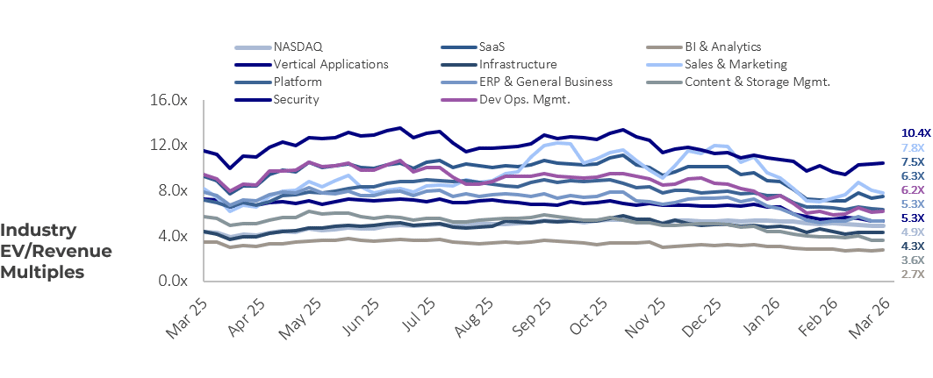
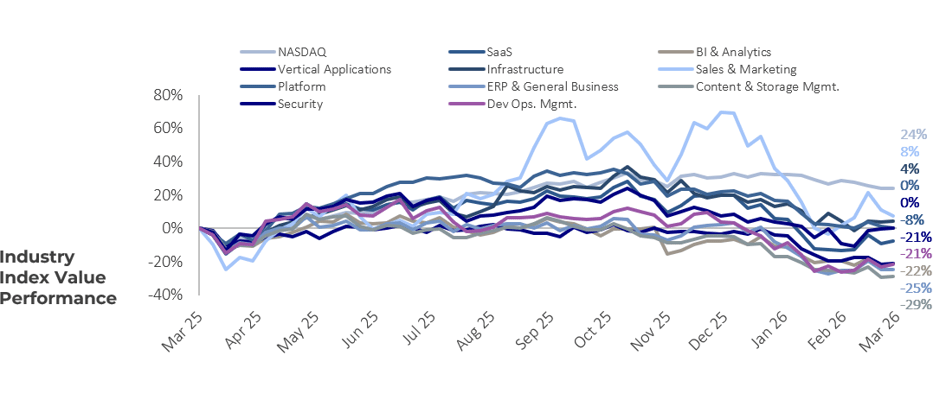
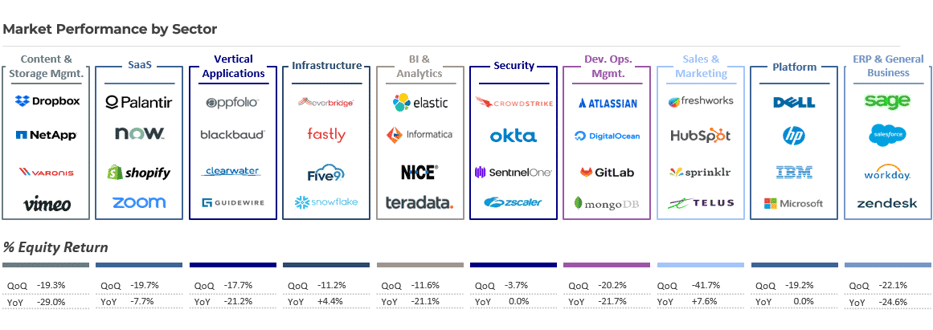
Public Technology industry multiples dropped meaningfully during the quarter. Enterprise Value to Revenue ratios fell across nearly every category, with SaaS down 26.1% from the prior quarter, Enterprise Resource Planning (ERP) & General Business down 28.7%, Content & Storage Management down 27.7%, and DevOps Management down 27.8%. Security held up best, slipping only 8.5% to 10.41x, and the NASDAQ composite multiple also proved resilient at 4.88x (down 8.7% for the quarter but still up 14.3% from a year earlier).
The weakness was broad. Since one year ago, cumulative declines of roughly 20% to 30% hit Vertical Applications, BI & Analytics, Content & Storage Management, ERP & General Business, and DevOps Management. Infrastructure, Sales & Marketing, Security, and Platform ended the quarter roughly flat to slightly positive over the same window.
Context helps explain how deep the selloff ran. The iShares Expanded Tech-Software ETF (IGV) fell more than 21% in Q1 2026, and January alone was the index's worst month since 2008.1 The selloff picked up steam after Anthropic rolled out new enterprise automation tools in February, which brought fresh attention to the "seat compression" idea: AI agents can now do work that software vendors used to charge for on a per-user basis.2 The broader economy added to the pressure. The Federal Reserve held its target range at 3.50% to 3.75% for the second meeting in a row in March, pointing to high uncertainty, and the Middle East conflict that started mid-quarter led investors to reprice riskier assets.3
Dinan Index Perspective
Equity Return (YoY)
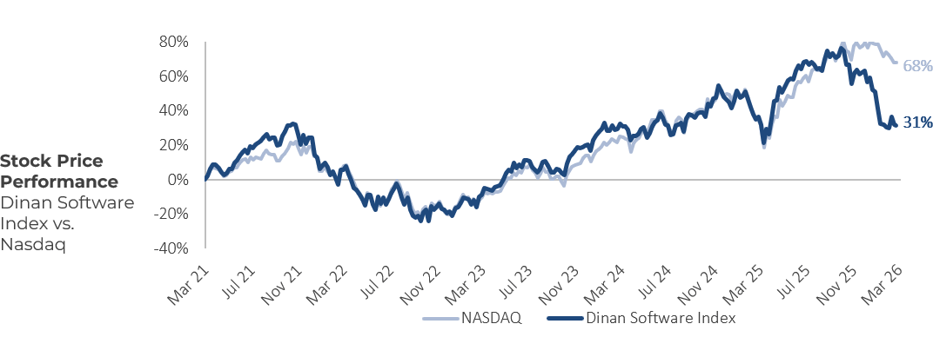
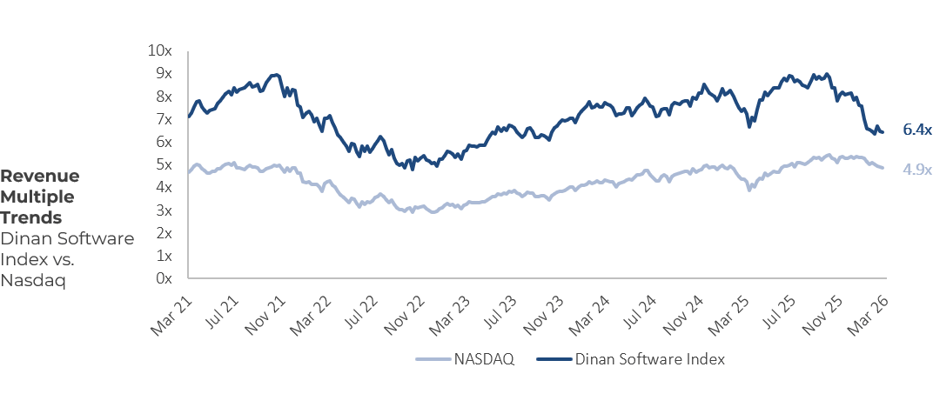
Mid-market software underperformed large-cap peers during the quarter. The Dinan Software Index†, a proprietary index of publicly traded mid-market software companies tracked by Dinan Capital Advisors, declined 19.6% for the quarter, compared with a 6.4% decline for the NASDAQ. Over the past year, the Dinan Software Index was essentially flat (down 0.6%), while the NASDAQ gained 27.5%.
As of quarter-end, the Dinan Software Index stood at a 6.44x revenue multiple versus 4.88x for the NASDAQ. Since inception in March 2021, the NASDAQ has returned 68.1%, compared with 31.3% for the Dinan Software Index, reinforcing the more pronounced pressure on mid-market software names relative to large-cap technology.
M&A Activity & Transaction Environment
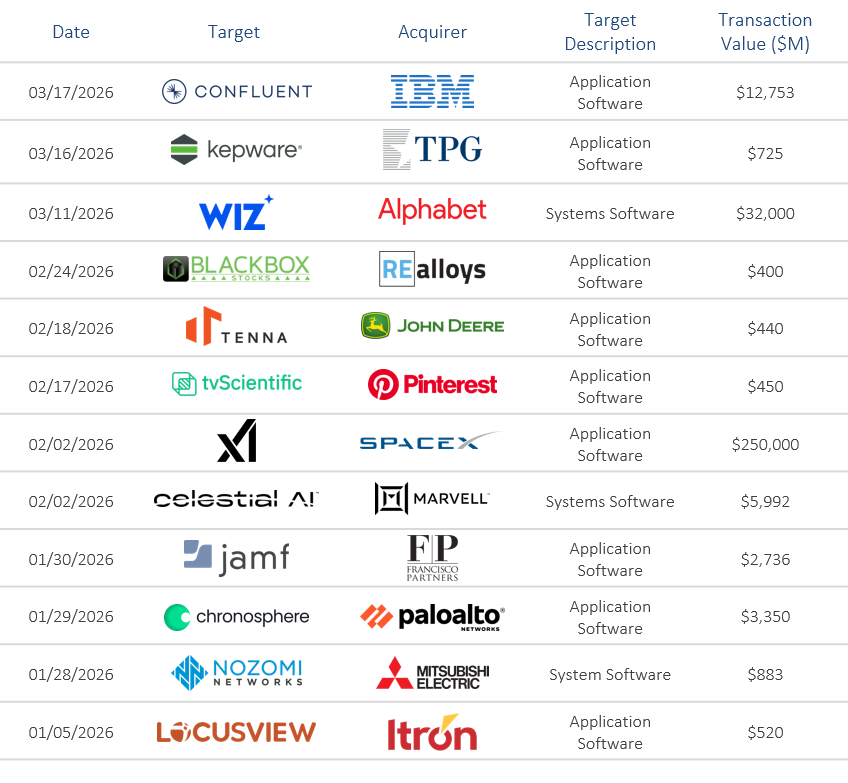
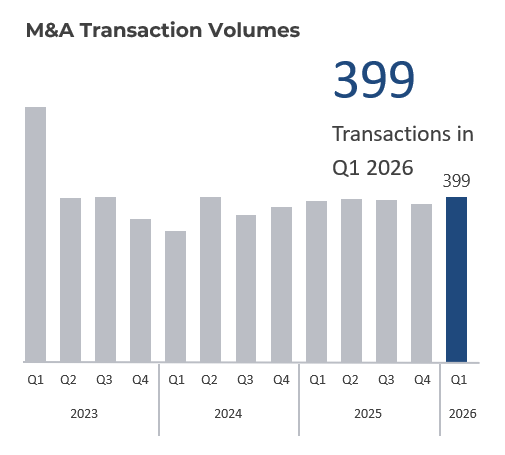
Public market weakness did not slow deal flow. Technology M&A volume reached 399 transactions in Q1 2026, up 4.5% from Q4 2025 and 2.0% from the same quarter last year. Disclosed deal value was concentrated in a handful of very large announcements, led by SpaceX's $250 billion acquisition of xAI, which brought together two of Elon Musk's companies into what Bloomberg called the most valuable private business in the world.4 Alphabet's $32 billion acquisition of cloud security firm Wiz came after the U.S. Department of Justice gave its approval, clearing away a key regulatory concern and opening the door for more cybersecurity consolidation.5 IBM's $12.75 billion acquisition of Confluent highlighted the premium being paid for AI-related data and infrastructure assets.
The common thread was AI capability. Strategic buyers and private equity firms are focusing on core assets like data centers, chips, AI-native software, and security platforms, with money flowing toward the most promising opportunities even as overall deal volume stays uneven.6 Cybersecurity continues to earn premium valuations as generative AI creates new ways for systems to be attacked and as more enterprise workloads move to the cloud.5
Outlook & What to Watch
The rest of 2026 will likely turn on three questions: how Fed policy moves, with the median FOMC projection still calling for one cut later this year3; how long the Middle East conflict lasts and how much it feeds through to inflation and investor mood; and how quickly strategic buyers turn AI plans into completed deals. Consolidation looks set to continue in vertical software, cybersecurity, and cloud infrastructure, where recurring revenue is strong and AI can add the most value. Middle-market owners with unique data, solid customer economics, and a clear AI story remain well positioned as buyers become more selective rather than less active. The gap between low public market prices and active strategic deal value is itself worth tracking. Recent improvement in market performance early in Q2, particularly the outperformance of Technology, also underscores the speed at which conditions are evolving in this dynamic environment.
† The Dinan Software Index is a proprietary index of publicly traded mid-market software companies maintained by Dinan Capital Advisors. Index composition is available upon request.
References
1 Carson Group. "Software's Selloff." February 2026; FinancialContent / Market Minute. "The 2026 'SaaSpocalypse': Why B2B Software Stocks Are Plunging 20%." March 24, 2026.
2 Axios. "AI software scramble: Anthropic triggers stock market slide." February 3, 2026.
3 Federal Reserve. FOMC Statement and Minutes, March 17–18, 2026; U.S. Bank. "Federal Reserve holds interest rates steady." March 2026.
4 Bloomberg News. "SpaceX Acquires xAI as Musk Prepares for Mega IPO." February 2, 2026.
5 PwC. "Technology: US Deals 2026 Outlook" (AI-fueled M&A). 2026.
6 PwC. "Global M&A Industry Trends: 2026 Outlook." January 2026.